
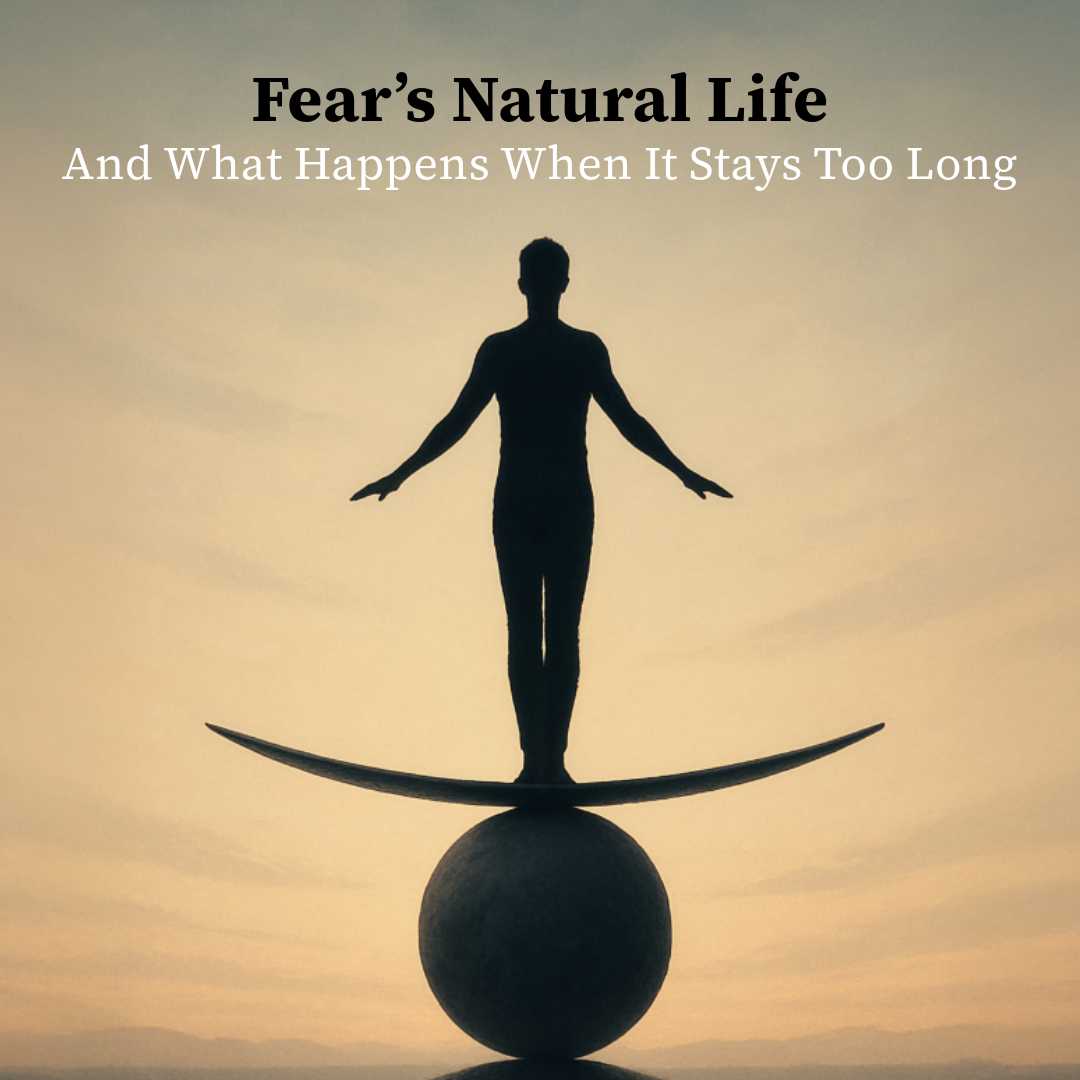
Modern science supports what our ancestors lived every day:
The chemical surge of fear passes through the body in about 90 seconds if left undisturbed.
Just enough time to recognize danger, respond to it, and move beyond it.
But in the lives we live now, the threats and dangers aren’t saber-toothed tigers or sudden storms we have to escape for survival.
They are slower, quieter, often created in the mind – as also is the relating fear.
When Fear Settles In
Instead of moving through and out, fear often gets caught.
The mind, always trying to protect our system, holds on to the signal.
It replays what happened, and it imagines what could happen next - or again.
It searches for more danger, just to be sure. To protect better.
And in that looping, fear loses its original purpose.
It no longer points to a specific short-term danger.
It becomes a background hum - an undercurrent in our system.
It’s a small, barely noticeable, shift at first.
But over time, it becomes the difference between living with open energy and living inside a constant quiet contraction.
Fear as a Memory, Not as a Moment
The body doesn’t forget easily.
When fear lingers longer than it was designed to, it weaves itself into the memory of the system.
At first, it might just be a tension in the shoulders.
Or a shallowness in the breath.
A hesitation of the needed movement at the edge of an opportunity.
These subtle changes in our behavior are rarely recognized, and if, even more rarely, connected to a certain fear that came to our system maybe weeks before.
But little by little, our system adapts.
The fear becomes a familiar part of how we feel, think, and move.
It becomes part of our comfort zone.
Not because the danger is still there - but because the body and mind have learned to live with the imprint.
And if one is always looking for danger, it is good to have some extra protection close by.
The Architecture We Don’t Remember Building
Over time, fear stops feeling like an emotion.
It starts to feel like reality.
A structure that quietly shapes how much we dream, how much we speak, how far we allow ourselves to go.
The most powerful architectures are the ones we don’t remember building.
And fear, once embedded, is a master builder.
It doesn’t need to convince us with words.
It only needs to be familiar enough that we stop questioning its presence.it
And it has plenty of time to reach this state, even before we are able to remember anything.
With current brain science, we realize more and more that the early years of our childhood are most significant.
How much can you remember from the first years of your life?
Here, it becomes obvious that we are not to blame for any fear that already lingers in us from those days.
In the next part, we’ll step even closer - into how these embedded fears begin to organize themselves inside the human system, and how, without realizing it, we start making choices that protect the fears more than they protect us.